

Blog
Managed IT Services in Oman: What an MSP Does and How to Evaluate SLAs

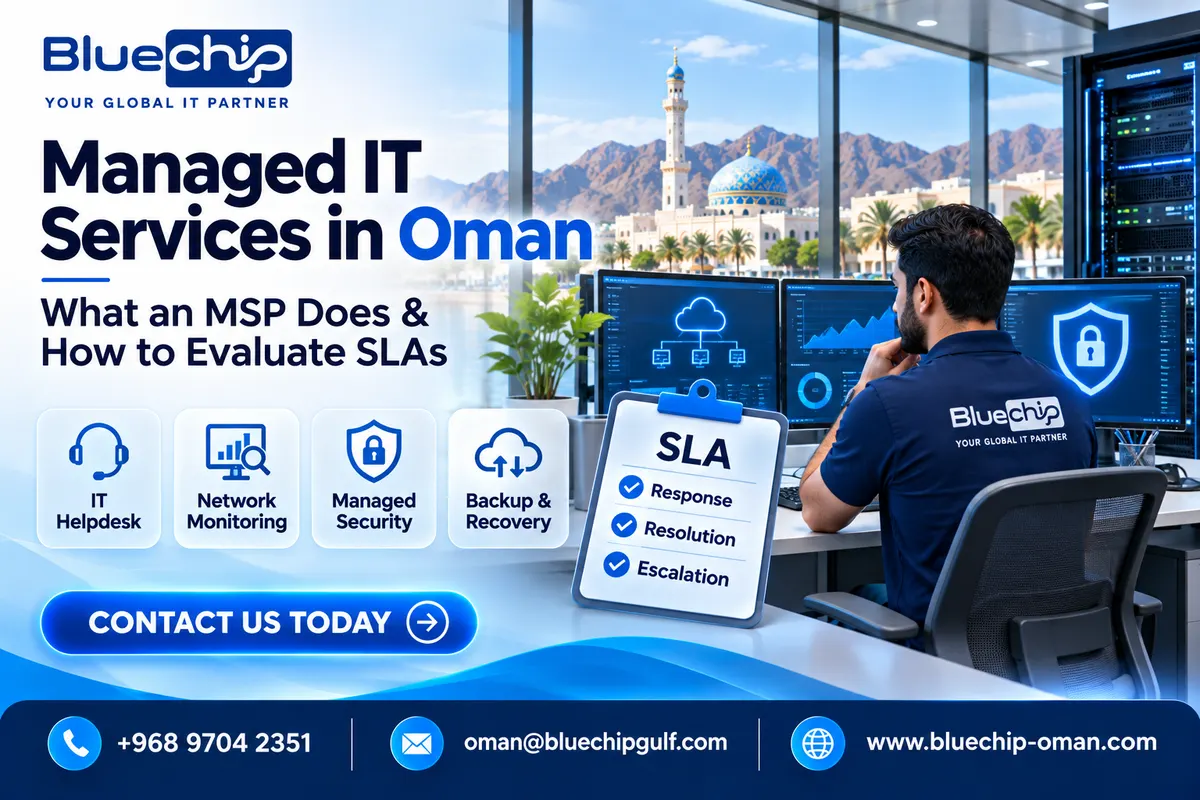
More and more businesses rely on technology to run their business operations, communicate with customers, and secure critical data. However, businesses must constantly ensure their servers, networks, cyber security, and staff devices are maintained. This can cause disruptions if not properly managed by an IT department.
Many organisations look to use managed IT services in Oman. An MSP will take responsibility for maintaining IT services as outlined within a service agreement.
Before choosing an IT provider you should know what a managed service provider can do and how to evaluate the SLA.
1. Know what an MSP can do
A managed service provider will manage and support your business’ IT infrastructure.
Depending on the agreement and the service required, the MSP will offer:
- IT support/helpdesk
- Network/server monitoring
- Cyber security/patching
- Data back-up/disaster recovery
- Cloud infrastructure management
- Hardware/software maintenance
- End user/device support.
This means you have access to experts if you don’t have a large internal IT team.
2. Understand what reactive and proactive IT support is
Traditionally IT would be reactive to issues but managed IT services are more proactive. They monitor your IT systems, identify any potential issues, and carry out regular maintenance.
This could include monitoring your servers so any issues can be picked up early on and not cause major disruption. Regular cyber security updates and back-up checks can also be carried out to reduce any unnecessary IT risk.
If you’re looking for IT managed services in Oman make sure the provider can tell you about their monitoring processes, incident identification, and potential issues.
3. Ensure the services are covered in the contract
Each managed service provider will differ in how much support they can offer. Some will offer full IT infrastructure management whilst others will only offer specific services.
Ensure the IT managed service provider in Oman you choose can offer:
- Workstation/server management
- Network monitoring
- Firewall/security management
- Back-up/support
- Software updates/patching
- Remote/on site support
- IT asset management.
Also ensure they can provide support for your specific location in Muscat.
4. Know the SLA response and resolution time
An SLA outlines the services offered by the provider, and how quickly they can be delivered.
One of the key things to know is the difference between response time and resolution time.
Response time is how quickly the provider will acknowledge and start to resolve any issues raised. Resolution time is how quickly the service will be restored.
A good SLA should outline:
- The severity of the incident, how quickly it will be responded to depending on the severity,
- How quickly it will be resolved,
- Who will be providing support, and when.
- It should also outline how they will keep you informed during any incidents.
- Avoid vague responses such as ‘fast’ support.
5. Ensure support is available and escalation processes
Your business may need out of hours support. If there is an issue with your servers or network it can cause disruption even if your IT team aren’t available.
When looking at managed IT support Oman, ensure they offer support during business hours, extended hours or 24/7.
The SLA should outline how incidents will be logged, categorised, prioritised and escalated. It should also outline how you should communicate with them.
If you require managed IT support services Muscat you may want to ensure they can provide local on site support for hardware issues.
6. Ensure specifics are covered, reporting, and data recovery
The SLA should outline exactly what is covered and what isn’t. Ensure you know if there are extra costs for replacing hardware, third party software, licences, emergency visits, and extra projects.
Reporting is also important. Regular reporting can give you insight into any incidents, repeating issues, maintenance and how your infrastructure is performing.
You should also know what back-up/disaster recovery they will be providing. Ensure they back up your data, how regularly, who will be monitoring it and what support they will provide.
This will help you understand what value you’ll actually be getting from your IT services in Oman.
7. Choose an MSP that can grow with your business
As your business grows, you’ll have more staff, new locations, and new applications. Your IT requirements will change.
A good provider should be able to review your changing requirements and adapt your support. Consider their technical expertise, communication, flexibility of services and ability to provide long term maintenance.
Why choose Bluechip Oman?
Bluechip Gulf Information Technology LLC offer managed IT services and IT support for businesses in Oman. This includes Muscat.
They offer a range of managed services including helpdesk support, network monitoring, server management, managed security, cloud services, data back-up and recovery, wireless equipment management, and remote monitoring.
They also offer an SLA based IT service agreement. They also publish their ticketing process which includes logging, categorising, prioritising, investigating, escalating, resolving and closing tickets.
If you’re looking for managed IT services Muscat you can talk to Bluechip Gulf about your infrastructure, support requirements and service levels.
Conclusion
Using managed IT services can help you to keep your technology infrastructure running. However, choosing the right MSP can be tricky.
Make sure you carefully review the SLA, know how quickly they’ll respond, what isn’t covered, and how they will handle support, reporting and data recovery.
If your organisation is looking for managed IT services Oman get in touch with Bluechip Gulf.